Tuesday, February 12, 2013

University of Bristol

1 comments
UNIVERSITY OF BRISTOL


The University of Bristol is a public research university located in Bristol, United Kingdom.[8] One of the British red brick universities, it received its Royal Charter in 1909,[9]although its predecessor institution, University College, Bristol, had been in existence since 1876.[10]
Bristol has been named inside the global top 30 by the QS World University Rankings.[11]It has an average of 14 applicants for each undergraduate place. The University had a total income of £408.8 million in 2010/11, of which £106.7 million was from research grants and contracts.[12] It is the largest independent employer in Bristol.[13]
Current academics include 18 Fellows of the Academy of Medical Sciences, 10 Fellows of the British Academy, 13 Fellows of the Royal Academy of Engineering and 31 Fellows of the Royal Society.[14]

History

Foundation


The earliest antecedent of the university was the engineering department of the Merchant Venturers’ Technical College (founded as a school as early as 1595) which became the Engineering faculty of Bristol University.[18] The University was also preceded by Bristol Medical School (1833) and University College, Bristol, founded in 1876,[10] where its first lecture was attended by only 99 students.[19] The University was able to apply for a Royal Charter due to the financial support of the Wills and Fry families, who made their fortunes in tobacco plantations and chocolate, respectively. The Wills Family made a vast fortune from the tobacco industry and gave generously to the city and University. The Royal Charter was gained in May 1909, with 288 undergraduates and 400 other students entering the University in October 1909. Henry Overton Wills III became its first chancellor.[10] The University College was the first such institution in the country to admit women on the same basis as men.[10] However, women were forbidden to take examinations in medicine until 1906.[20]

Campus

Some of the University of Bristol's buildings date to its pre-charter days when it was University College Bristol. These buildings were designed by Charles Hansom, the younger brother ofJoseph Hansom, Joseph being the inventor of the Hansom Cab. These buildings suffered being built in stages due to financial pressure. George Oatley added to them a tower in memory of Albert Fry which can still be seen on University Road. The first large scale building project the University of Bristol undertook on gaining a charter was the Wills Memorial Building which it was hoped would be a symbol of academic permanence for the University and a memorial to the chief benefactor of the University Henry Overton Wills. It was requested to the architect George Oatley that the building be built to last at least 400 years but the site purchased, at the top ofPark Street suffered from an awkward slope and a desirability to link the building with the Museum and Art Gallery situated adjacent to the plot. The architecture critic Roger Gill has stated that the building is "remarkable in size" but noted that the "ambience of a medieval University was strangely lacking". He goes on to criticise the building as a "sham" and a "folly".[55] The armorials on the Founder's Window represent all of the interests present at the founding of the University of Bristol including the Wills and Fry families. The Tyndalls Park Estate and Royal Fort House were also purchased from the trustees of the Tyndall family allowing the University to expand. Many Departments in the Faculty of Arts are housed in large Victorian houses which have been converted for teaching.[56]
Goldney gardens entered the property of the University of Bristol through George Wills who had hoped to build an all male hall of residence there. This was prevented due to the moral objection of the then warden of Clifton Hall House who objected to the idea of male and female residences being in such close proximity. University records show that Miss Starvey was prepared to resign over the issue and that she had the support of the then Chancellor Conwy Lloyd Morgan.[57] Eventually land was purchased in Stoke Bishop allowingWills Hall to be bought, allowing the building of what has been described as a "quasi-Oxbridge" hall, to which was added the Dame Monica Wills Chapel added by George Wills' widow after his death.

The Gardens of Goldney Hall were acquired by the Wills family
Burwalls, a mansion house on the other side of the Avon Gorge, was used as a halls of residence in the past and was a home of Sir George Oatley. The building is now used to house the Centre for Continuing Education.[58]
Many of the more modern buildings, including Senate House and the newer parts of the HH Wills Physics Laboratory, were designed by Raplh Brentnall after funds from the University Grants Committee. He is also responsible for the extension to the Wills Memorial Building library which was completed to such standard that few now realise that is an extension to the original building.[59] Brentnall oversaw the rebuilding of the Great Hall of the Wills Memorial Building after it was partly destroyed during the Bristol Blitz of World War II. The buildings of St Michael's Hill were rebuilt using hundreds of old photographs in order to recreate the original houses. The flats at Goldney Hall were designed by Michael Grice and received an award from the Civic Trust for their design.[60] Bristol University owns some of the best examples of Georgian architecture in the city, the best examples being Royal Fort House, Clifton Hill House and Goldney Hall despite some additions.[61] The Victoria Rooms which house the Music Department were designed by Charles Dyer and is seen as a good example of a Greek revival movement in British architecture. The tympanum of the building depicts a scene from The Advent of Morning designed by Jabez Tyley.[62] Its major feature was a large organ which has since been destroyed by fire.

Academic structure 

Faculty of Arts

Drama: Theatre, Film and Television


  • History of Art
  • Music
  • Philosophy
  • Classics and Ancient History
  • English
  • Historical Studies
  • Theology and Religious Studies
  • French
  • German
  • Hispanic, Portuguese and Latin American Studies
  • Italian
  • Russian (which also includes Czech)
  • Faculty of Engineering

    • Aerospace Engineering
    • Civil Engineering
    • Computer Science
    • Electrical and Electronic Engineering
    • Engineering Mathematics
    • Mechanical Engineering
    • Engineering Design
    • Faculty of Medical and Veterinary Sciences

      • Anatomy
      • Biochemistry
      • Cellular & Molecular Medicine
      • Clinical and Pre-Clinical Veterinary Science
      • Neuroscience
      • Physiology and Pharmacology
      • Faculty of Science

        • Biological Sciences
        • Chemistry
        • Earth Sciences
        • Experimental Psychology
        • Geographical Sciences
        • Mathematics
        • Physics
        • Animal Behavior and 

          Faculty of Medicine and Dentistry

          • Clinical Science at North Bristol
          • Clinical Science at South Bristol
          • Community-Based Medicine
          • Oral & Dental Science
          • Social MedicineWelfare
        • Faculty of Social Sciences and Law

          • Audiology
          • Social Work
          • Education (Graduate School of)
          • Geographical Sciences (affiliated)
          • Policy Studies
          • Deaf Studies
          • Hearing and Balance Studies
          • Exercise, Nutrition and Health Sciences
          • Accounting and Finance
          • Economics
          • Management
          • Law
          • School of Sociology Politics and International Studies (SPAIS)

Continue reading →

Privacy Policy

0 comments
 Privacy Policy

We take your privacy seriously. This policy describes what personal information we collect and how we use it. (This privacy policy is applicable to websites falling under the primary holder 
http://universityalloverworld.blogspot.com/
Routine Information Collection
All web servers track basic information about their visitors. This information includes, but is not limited to,IP addresses, browser details, time stamps and referring pages. None of this information can personally identify specific visitors to this site. The information is tracked for routine administration and maintenance purposes, and lets me know what pages and information are useful and helpful to visitors.

Cookies and Web Beacons
Where necessary, this site uses cookies to store information about a visitor's preferences and history in order to better serve the visitor and/or present the visitor with customized content.
Advertising partners and other third parties may also use cookies, scripts and/or web beacons to track visitors to our site in order to display advertisements and other useful information. Such tracking is done directly by the third parties through their own servers and is subject to their own privacy policies.

Controlling Your Privacy
Note that you can change your browser settings to disable cookies if you have privacy concerns. Disabling cookies for all sites is not recommended as it may interfere with your use of some sites. The best option is to disable or enable cookies on a per-site basis. Consult your browser documentation for instructions on how to block cookies and other tracking mechanisms.

Special Note About Google Advertising
Any advertisements served by Google, Inc., and affiliated companies may be controlled using cookies. These cookies allow Google to display ads based on your visits to this site and other sites that use Google advertising services. Learn how to opt out of Google's cookie usage. As mentioned above, any tracking done by Google through cookies and other mechanisms is subject to Google's own privacy policies.
About Google advertising: What is the DoubleClick DARTcookie? The Double Click DART cookie is used by Google in the ads served on publisher websites displaying AdSense for content ads. When users visit an AdSense publisher’s website and either view or click on an ad, a cookie may be dropped on that end user’s browser. The data gathered from these cookies will be used to help AdSense publishers better serve and manage the ads on their site(s) and across the web. Users may opt out of the useof the DART cookie by visiting the Google ad and content network privacy policy.

Contact Information
Concerns or questions about this privacy policy can be directed to http://universityalloverworld.blogspot.com/  for further clarification.
Continue reading →
Tuesday, February 5, 2013

University of Florida

1 comments


University of Florida


History

The University of Florida traces its origins to 1853, when the East Florida Seminary, the oldest of the University of Florida's four predecessor institutions, was founded in Ocala, Florida.
On January 6, 1853, Florida Governor Thomas Brown signed a bill that provided public support for higher education in the state of Florida.[17] Gilbert Kingsbury was the first person to take advantage of the legislation, and established the East Florida Seminary. The East Florida Seminary was the first state-supported institution of higher learning in Florida.[18] James Henry Roper, an educator fromNorth Carolina and a state senator from Alachua County, built a school, theGainesville Academy, around the same time. In 1866, after East Florida Seminary had closed during the American Civil War,[19] Roper offered his land and school to the State of Florida in exchange for the relocation of East Florida Seminary to Gainesville.[20]
The second major precursor to the University of Florida was the Florida Agricultural College, established at Lake City by Jordan Probst in 1884. Florida Agricultural College became the state's first land-grant college under the Morrill Act. In 1903, the Florida Legislature, desiring to expand the school's outlook and curriculum beyond its agricultural and engineering origins, changed the name of Florida Agricultural College to the "University of Florida," a name that the school would hold for only two years.[21]

Academics

Tuition 

For the 2008-2009 academic year, annual undergraduate tuition was $3,790 for in-state students and $20,460 for out-of-state students.[37] For the 2008-2009 academic year, annual graduate tuition was $8,190 for in-state students, and $23,315 for out-of-state students. For the 2008-2009 academic year, annual law school tuition was $10,800 for in-state students, and $30,100 for out-of-state students.[38] For the 2008-2009 academic year, annual medical school tuition was $23,930 for in-state students, and $51,777 for out-of-state students.[39] For the 2009-2010 academic year, annual undergraduate tuition was $5,044 for in-state students and $27,321 for out-of-state students. [40]

Demographics


University of Florida students, numbering 51,413 in Fall 2008, come from more than 130 countries, and all 50 states. The ratio of women to men is 54:46, and 32 percent are graduate and professional students. Professional degree programs include architecture, dentistry, law, medicine, pharmacy and veterinary medicine. Minority populations constitute 33.5 percent of the student body, with 10.0 percent African-Americans, 15.0 percent Hispanics, 0.5 percent Native American, and 8.0 percent Asian-Americans or Pacific Islanders.[43]

Over 12,000 students, or nearly a quarter of University of Florida students come from the Miami/South Florida area, constituting the largest group of students at the university. The majority of Hispanicand Jewish students at the university are Miamians, with an estimated 6,000 Hispanic and 10,000 Jewish students at UF. Broward County alone produces the most UF students followed by Miami-Dade County.[44]

During the 2008-2009 academic year the University of Florida had the 12th highest enrollment for International Students in the United States. In total 4,731 international students enrolled at the university and this equates to about 9 percent of the total enrollment.[45] This was more than any other university in Florida. Also confirmed by Peterson's the International Student populations accounts for roughly 9.0% of the entire student body.[46]

The University of Florida is ranked second overall in the United States for the number of bachelor's degrees awarded to African-Americans, and third overall for Hispanics.[47] The university ranks fifth overall in the number of doctoral degrees awarded to African-Americans, and second overall for Hispanics, and third overall in number of professional degrees awarded to African-Americans, and second overall for Hispanics.[48] The university offers many graduate programs—-including engineering, business, law and medicine—-on one contiguous campus, and coordinates 123 master's degree programs and 76 doctoral degree programs in 87 schools and departments.[49][50]
Ethnic composition of student body[41]
Student BodyU.S. Census[42]
Hispanic American (of any race)15.0%14.7%
Asian American8.0%4.3%
White (non-Hispanic)66.5%73.9%
African American10.0%12.4%
Native American0.5%0.8%
International students9.0%(N/A)


Admissions


As the acceptance rate at the University of Florida has trended downward, the application process has become increasingly competitive. The university has a freshmen retention rate of 94%.[76] Approximately 90 percent of incoming freshmen score above the national average on standardized exams. For the Fall of 2011, admitted freshman applicants had an average grade-point average (GPA) of 4.3, a 1963 SAT score, and a 30 ACT score.[77]

In addition, UF admitted 1,179 International Baccalaureate students during the fall 2009 academic year. This was more than any other university in theUnited States.[78]


Freshmen First Time in College Statistics
20112010200920082007
Applicants29,26926,51225,79826,32624,126
Admits11,42311,45910,82110,91610,158
 % Admitted39.043.241.941.542.1
Recreation

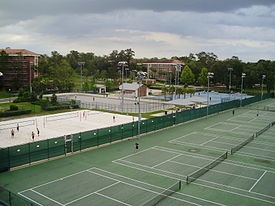
Many recreational activities available for students include indoor and outdoor sports, outdoor courts and playing fields on campus, in the O'Connell Center,University Golf Course, Plaza of the Americas, the Student Recreation and Fitness Center, the Southwest Recreation Center, and the Florida Gymnasium for indoor sports.[138] Florida offers intramural and club sports ranging from archery to weightlifting.[138] Near the campus are many recreational lakes and rivers, including university-owned Lake Alice.[138] In addition, student have access to the J. Wayne Reitz Union which is equipped with a bowling alley, pool tables, an arcade, and numerous other activities. South of Gainesville is Lake Wauburg, which also provides recreational activities for students, faculty, and staff. To the northwest of campus is the Devil's Millhopper Geological State Park.
The campus also contains open spaces, small ponds, picnic areas, shady nooks and an 81-acre (330,000 m2) wildlife sanctuary that provide opportunities to enjoy Florida's year-round sunshine activity life.[138]
Lastly, the University of Florida has more than eight hundred organizations and clubs for students to join.[139] They range from cultural and athletic to subjects pertaining to philanthropy. Some of the most popular organizations are Florida Blue Key, Theatre Strike Force, the Marching Band, Florida Competitive Cheerleading, Dazzlers, the Gatorettes, Hillel at UF, Gator Growl, Progressive Black Journalists, Miss University of Florida, and the Speakers Bureau. If students wish they can create their own registered student organization if the current interest or concern is not addressed by the previously established entities.[140]

Sports

The University of Florida's intercollegiate sports teams, known as the "Florida Gators", compete in National Collegiate Athletic Association (NCAA) Division I and the Southeastern Conference (SEC).[165] For the 2009–2010 school year, the University Athletic Association budgeted more $85 million for its sports teams and facilities. Since 1986, the Gators have won twenty-three of the last twenty-six SEC All-Sports Trophies, recognizing Florida as the best overall athletics program in the SEC.[166] Florida's sports program has ranked among the top five in the nation in twenty of the past twenty-eight years, and it is the only Division I program that has ranked among the top ten athletic programs in the country in each of the last twenty-eight years.[167]
Florida has won a total of twenty-nine team national championships,[168] twenty-three of which are NCAA championships.[169] Florida is one of only two Division I FBS universities to win multiple national championships in each of the two most popular NCAA sports: football (1996, 2006, 2008) and men's basketball (2006, 2007).


Football


The University of Florida fielded its first official varsity football team in the fall of 1906, when the university held its first classes on its new Gainesville campus. Since then, theFlorida Gators football team has played in thirty-seven bowl games, won three consensus national championships and eight Southeastern Conference (SEC) championships, produced 135 All-Americans, thirty-five National Football League (NFL) first-round draft choices, and three Heisman Trophy winners.[171]
The Gators won their first post-season game on Christmas Day 1912 in the Bacardi Bowl, beating the Vedado Athletic Club 28–0 in Havana, Cuba.[172] The Gators earned national attention in 1928, setting a national record for most points scored in a season by an 8–1 team that also produced the Gators' first All-American, end Dale Van Sickel.[173] The Gators' first major bowl win was the 1967 Orange Bowl in which coach Ray Graves and Heisman Trophy quarterbackSteve Spurrier led the Gators to a 27–12 victory over the Georgia Tech Yellow Jackets.
In 1990, Spurrier returned to his alma mater as its new head coach, and spurred the Gators to their first six official SEC football championships. The Gators, quarterbacked by their second Heisman Trophy winner, Danny Wuerffel, won their first national championship in 1996 with a 52–20 victory over Florida State Seminoles in the Sugar Bowl. In 2006, Urban Meyer coached the Gators to a 13–1 record, capturing their seventh SEC Championship, and defeating the top-ranked Ohio State Buckeyes 41–14 for the BCS National Championship. In 2008, the Gators' third Heisman-winning quarterback, Tim Tebow, led them in a 24–14 BCS Championship Game victory over the Oklahoma Sooners for their third national championship.
Since 1930, the Gators' home field has been Ben Hill Griffin Stadium, which seats over 90,000 fans—the twelfth largest college football venue in the country.[174] The stadium is popularly known as "The Swamp", and The Sporting News has named Florida's fans as the top college crowd in the nation and ranked the stadium as the nation's loudest.[175]


Continue reading →
Monday, February 4, 2013

University of California,Berkeley

0 comments


University of California,Berkeley


The University of California, Berkeley (also referred to as UC Berkeley, Berkeley,California, or simply Cal) is a public research university located in Berkeley, California, United States. The university occupies 1,232 acres (499 ha) on the eastern side of theSan Francisco Bay with the central campus resting on 178 acres (72 ha).[5] Berkeley is among the most selective public universities in the United States.[6] It offers approximately 350 undergraduate and graduate degree programs in a wide range of disciplines.[7]
Established in 1868 as the result of merger of the private College of California and the public Agricultural, Mining, and Mechanical Arts College in Oakland, Berkeley is the oldest of the ten major campuses affiliated with the University of California (UC). Berkeley has been charged with providing both "classical" and "practical" education for the state's people and is the flagship institution in the University of California system.[8][9] Berkeley co-manages three United States Department of Energy National Laboratories, including the Los Alamos National Laboratory, Lawrence Livermore National Laboratory andLawrence Berkeley National Laboratory for the U.S. Department of Energy.
Berkeley faculty, alumni, and researchers have won 71 Nobel Prizes (including 28 alumni Nobel laureates), 9 Wolf Prizes, 7 Fields Medals, 15 Turing Awards, 45 MacArthur Fellowships,[10] 20 Academy Awards, and 11 Pulitzer Prizes. To date, UC Berkeley and its researchers are associated with 6 chemical elements of the periodic table(Californium, Seaborgium, Berkelium, Einsteinium, Fermium, Lawrencium) and Berkeley Lab has discovered 16 chemical elements in total – more than any other university in the world.[11] Berkeley is a founding member of the Association of American Universities and continues to have very high research activity with $652.4 million in research and development expenditures in 2009.[12][13] Berkeley physicist J. Robert Oppenheimer was the scientific director of the Manhattan Project that developed the first atomic bomb in the world, which he personally headquartered at Los Alamos, New Mexico, during World War II.
Known as the California Golden Bears (often shortened to "Cal Bears" or just "Cal"), the athletic teams are members of both the Pacific-12 Conference and the Mountain Pacific Sports Federation in the NCAA. Cal athletes have won national titles in many sports, including football, men's and women's swimming, men's basketball, baseball, men's gymnastics, softball, water polo, rugby, and crew. The official colors of the university and its athletic teams are Yale Blue and California Gold.

Rankings

The 2012 Shanghai Jiao Tong University's Academic Ranking of World Universities ranked Berkeley 4th in the world and the United States and 2nd in California. In terms of "fields", Berkeley is ranked 2nd in Natural Sciences and Mathematics, 3rd in Engineering/Technology and Computer Science, 3rd in Social Sciences, 15th in Life and Agricultural Sciences, and 30th in Clinical Medicine and Pharmacy. In its "subject" ranking, Berkeley is ranked 2nd in Chemistry, 3rd in Mathematics, 3rd in Computer Science, 3rd in Physics, and 4th in Economics/Business.[39] According to the US News & World Report Subject Rankings, Berkeley is ranked 4th in Arts & Humanities, 3rd in Engineering & IT, 5th in Life Sciences and Biomedicine, 5th in Natural and Physical Sciences, and 5th in Social Sciences.
Berkeley is ranked 5th among 300 Best World Universities in 2012 compiled by Human Resources & Labor Review (HRLR) on Measurements of World's Top 300 Universities Graduates' Performance .[40]
University rankings
National
ARWU[41]4
Forbes[42]50
U.S. News & World Report[43]21
Washington Monthly[44]5
Global
ARWU[45]4
QS[46]21
Times[47]9
In 2012, the Times Higher Education World University Rankings named Berkeley the world's 5th most prestigious university, and one of six globally recognized "super brands."[48] The 2012-2013 Times Higher Education World University Rankings placed Berkeley 9th in the world, 6th in the United States, and 3rd in California.[49] The QS World University Rankings placed Berkeley 21st in the world, 14th in the United States, and 3rd in California.[50] (In 2010, the Times Higher Education World University Rankings and QS World University Rankings parted ways to produce separate rankings.) In 2009 the Center for Measuring University Performance placed Berkeley ninth among national research universities.[51]
In 2013 Kiplinger ranked Berkeley 8th out of the top 100 best-value public colleges and universities in the nation, and 2nd in California.[52]
Berkeley ranks 9th among universities that have produced the largest number of living billionaires.[53]
The Princeton Review ranks Berkeley as a "college with a conscience"[54] and the 5th best value in public colleges.[55]
The College Sustainability Report Card, published by the Sustainable Endowments Institute, gave Berkeley a B in 2009 for its efforts in environmental sustainability.[56]

[edit]Undergraduate programs

Berkeley's undergraduate program was ranked the top public university among "National Universities" in the United States by U.S. News & World Report.[57][when?] In 2009, UC Berkeley was ranked 3rd by Washington Monthly and in 2012, 21st among National Universities by U.S. News & World Report.[58][59] U.S. News ranked both the undergraduate programs in engineering and business tied for 3rd in the nation.[60][61]
The Wall Street Journal's Rankings by Major place Berkeley in 2nd place for Computer Science, 3rd for both Marketing/Advertising and Finance, 6th for Business/Economics, 8th for Accounting, and 12th for Engineering.[62]

Graduate programs

U.S. News & World Report ranks UC Berkeley's professional programs among the best in the country in 2012. The Haas School of Business and Boalt School of Law both come in at 7th, while the Goldman School of Public Policy is ranked 6th, and the UC Berkeley School of Public Health is ranked 8th. UC Berkeley's graduate sciences also receive high marks, ranking 1st in Chemistry and Computer Science; 2nd in Math, Statistics, and Biological Sciences; 3rd in Earth Sciences; and 5th in Physics. UC Berkeley's graduate Engineering program is 3rd in overall quality, with specialty rankings of 1st in Civil Engineering and Environmental/Environmental Health Engineering; 2nd in Chemical Engineering; and 3rd in Computer Engineering, Electrical/ Electronic/ Communications Engineering, Industrial/ Manufacturing Engineering and Mechanical Engineering. The graduate social science programs at Berkeley score 1st in English, History, Psychology, and Sociology; and 6th in Economics and Political Science.[63]Faculty in the English Department have received 25 university Distinguished Teaching Awards—more than any other department.
The most recent (2010) United States National Research Council Rankings, widely considered the ranking authority on US doctoral programs, identified UC Berkeley as having the highest number of top-ranked doctoral programs in the nation. Of all US research universities, UC Berkeley has the most graduate programs that extend into the top ten, with 48 out of 52 programs that were ranked, as well as the most programs with ranks that extend into the top 5, with 43 out of 52 ranked programs. UC Berkeley has the second highest number of graduate programs with a ranking of #1, with 16 out of 52 reaching top status—for comparison, Harvard achieved this level in 19 of its 52 ranked programs, while Stanford achieved it in 11 of its 47 ranked programs.[64] UC Berkeley doctoral programs that received a #1 ranking include Agricultural and Resource Economics, Astrophysics, Chemistry, Civil and Environmental Engineering, Computer Science, English, Epidemiology, German, Mathematics, Mechanical Engineering, MCB: Biochemistry and Molecular Biology, MCB: Genetics, Genomics, and Development, Physics, Plant Biology, and Political Science.
UC Berkeley was also the #1 recipient of National Science Foundation Graduate Research Fellowships between 2001 and 2010, with 1,333 awards. The next closest were MIT at 1,242 and Stanford at 1,070.[65]


Organization and administration 

Berkeley is the oldest of the ten major campuses affiliated with the University of California. The University of California is governed by a 26-member Board of Regents, 18 of which are appointed by the Governor of California to 12-year terms, 7 serving as ex officiomembers, and a single student regent.[76] The position of Chancellor was created in 1952 to lead individual campuses. The Board appointed Robert J. Birgeneau the 9th Chancellor of the university in 2004.[77] 12 vice chancellors report directly to the Chancellor. The Executive Vice Chancellor and Provost serves as the chief academic officer and is the office to which the deans of the 14 colleges and schools report.[78]
Berkeley's 130-plus academic departments and programs are organized into 14 colleges and schools in addition to UC Berkeley Extension.[79] "Colleges" are both undergraduate and graduate, while "Schools" are generally graduate only, though some offer undergraduate 


University finances


UC Berkeley receives funding from a variety of sources, including federal and state authorities, and private donors. With the exception of government contracts, public money is proportioned to UC Berkeley and the other 9 universities of the University of California system through the UC Office of the President.
Due in part to the 2008–11 California budget crisis, the state of California has reduced its educational appropriations to the University of California.[84] State educational appropriations such as general support given in the state's annual budget, and appropriations given to the state through the federal American Reinvestment and Recovery Act (ARRA) dropped $37M in 2010-11 from the previous calendar year. The university projects that state general support will drop from 15% to 11% of the university's total revenues in 2011-12. State budget shortfalls as well as rising costs in pensions have been cited by the university as two of the leading reasons for its current financial woes. During the formulation of the 2011-12 UC Berkeley budget, the university projected that it will have a $200M funding gap in the 5 years after that year's budget. In response to revenue shortfalls, the UC Regents have raised tuition, and the university is trying to increase the number of non-resident undergraduates, who will pay the more costly out-of-state tuition. Nearly 1/3rd of revenues from tuition and other student fees are returned to students as scholarships and fellowships.[85]


Continue reading →